March 25, 2026
Meta Ads for Education Businesses: a complete guide to attract and enroll students

Meta Ads are one of the most powerful tools for education businesses, but they are also one of the most misunderstood. If you run a school, academy, online course, or tutoring business, traditional advertising strategies often fail. This isn’t because Meta Ads don’t work for education businesses, but because this sector requires trust, emotional connection and a structured funnel strategy.
In this guide, you’ll learn how Meta Ads actually work for education businesses, why most Facebook and Instagram ads for education fail, how to structure campaigns that attract qualified students and how to adapt your strategy to modern Meta algorithms. What we are offering is not just theory, but a practical framework built specifically for education businesses like yours.
Meta Ads are one of the best channels for education businesses because they allow you to:
This is crucial, because most students (or parents) are not ready to enroll the first time they see you. Education is a high-trust, high-consideration type of decision. This means your ads must do more than generate clicks - they must be able to create a connection with your target audience.
So why do most ad campaigns end up not achieving the desired results? There is one simple reason for this: they try to sell too quickly without giving the right type of information. The most common mistake is promoting the course, like its monetary value and/or the content of the modules, instead of focusing the audience's attention on the outcome. This approach copies e-commerce ad campaign strategies, but it doesn't work the same for the education sector. Pressuring a cold audience into ‘Buy now’ call to actions results in low quality leads, wasted budget and a lot of frustration.
To understand how to fix this, first we need to look at the classic funnel model.
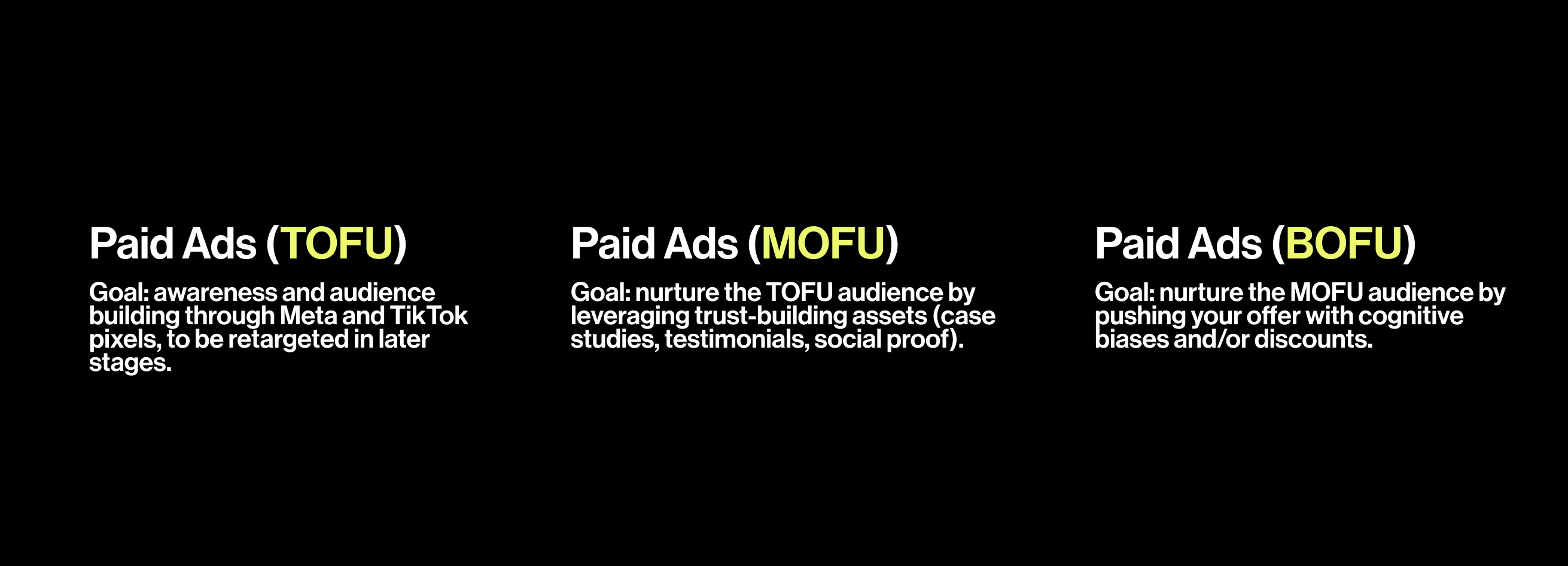
If you’ve never run ads before, the idea of a “funnel” might sound complex. In reality, a funnel is just a way to describe how a stranger becomes a customer, or in this case a student. People don’t usually see an ad and “bu”’ immediately - especially when it comes to formation. They need time to understand the problem, trust the solution, and feel confident about their decision. The classic paid advertising model breaks this journey into three simple stages: TOFU, MOFU, and BOFU. Each stage has:
This model works, but it’s important to understand both how it works and its limitations.
In traditional paid advertising, the idea is to guide the same person through multiple steps, instead of asking them to buy immediately.
Here’s what happens:
The downside? You pay the ad platforms multiple times for the same person. The same user:
And each step requires a budget. That’s why this model is often used by brands with:
Still, this is the foundation of most paid advertising, and it’s essential to understand.
TOFU stands for “Top Of The Funnel”. At this stage the main goal is to reach new people and build warm audiences. People don’t know you yet and they might have just started browsing for courses and schools. The last thing you want to do right now is to sell them something. The real asset here is not getting the conversion, but building an interested audience you’ll retarget later. So here you will typically run ads optimized for: video views, engagement traffic and reach to collect the data via the Meta pixel (video viewers, page visitors, engagers).
TOFU content focuses on:
There are no offers or pressure to buy - all you need to do is trying to grab the attention.
MOFU = Middle of Funnel. Here the goal is to build trust and clear out any doubts. You will retarget people who watched your videos, engaged with your content and visited your website. It is not time for pushing the offer quite yet, but you are building trust by answering the unspoken question “Why should I trust you?”.
MOFU ads typically include:
BOFU= Bottom Of The Funnel. At this point you are ready to turn warm audience into customers. This is where you can use scarcity strategies and leverage cognitive biases to push your offer (learn more about cognitive biases and how to use them in our article……)
Typical BOFU CTA are:
It will work because the trust has been built and the decision feels safer.
The TOFU–MOFU–BOFU model still works, but advertising platforms have changed. After Meta’s Andromeda update, simplicity is no longer rewarded. In the past, you could run one campaign, one ad set, one ad and you would get pretty fast conversions. Today, that approach almost never works. Modern platforms now reward creative and strategic variability. They especially reward angle variability. Angle variability means selling the same service from different perspectives. It’s not relying on minor variations of the same ad as it used to happen before, instead it’s a strategy that tests multiple psychological approaches to market a product. It aims to target different pain points, different desires and different motivations. This is the main point education business owners struggle with.
Angle 1 - Pain Relief (Fear & Stress Reduction)
Core pain:
“I don’t understand math and I’m falling behind.”
Strategic message:
Math isn’t the problem - the method is.
Ad concept:
“Your child isn’t bad at math. They just haven’t had the right explanation yet.”
Why it works:
Angle 2 - Performance & Results
Core desire:
Better grades, passing exams.
Strategic message:
Structured tutoring creates results.
Ad concept:
“From struggling with equations to top grades - with a clear, proven method.”
Why it works:
Angle 3 - Confidence & Identity Shift
Core motivation:
“I want to feel smart and independent.”
Strategic message:
Confidence changes everything.
Ad concept:
“Stop memorizing formulas. Start understanding math - for real.”
Why it works:
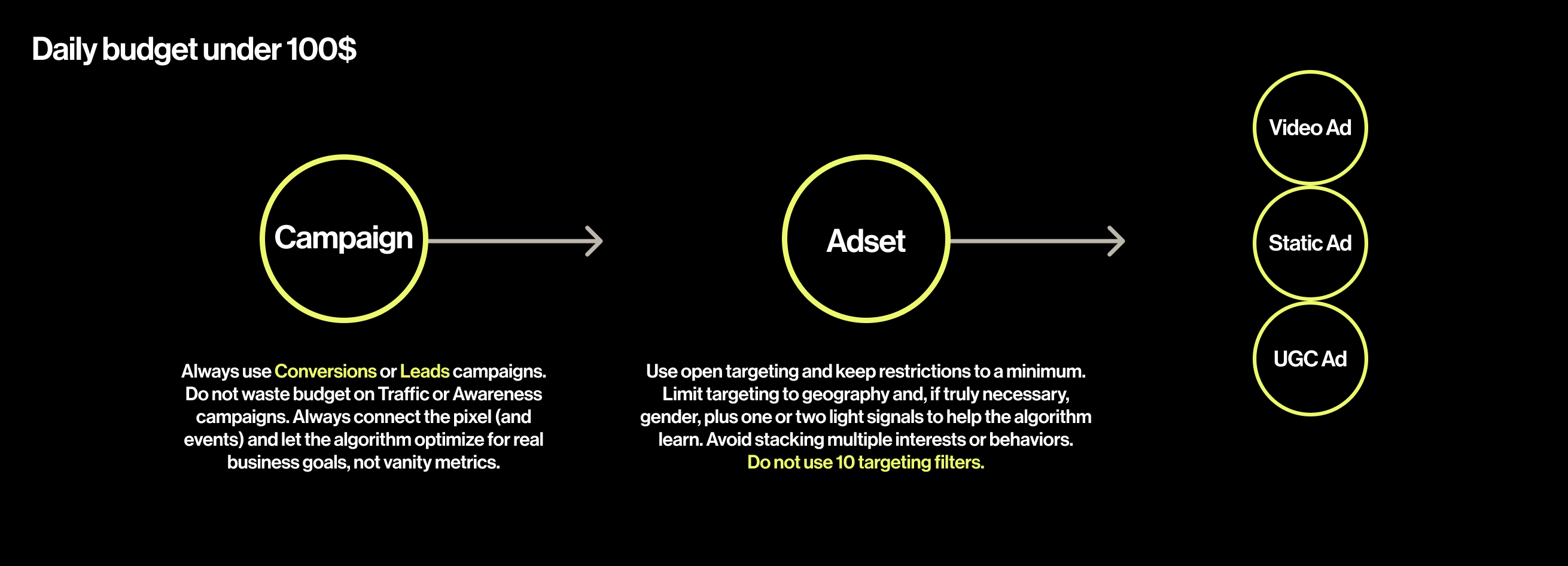
When starting, a $100/ day budget for ad campaigns feels like a lot of money. It’s normal to feel scared to invest a consistent budget when you are unsure of the conversion rate, but in fact at this stage you just need a smaller budget to taste the waters. It will work as long as the campaign is set up properly.
Recommended setup:
Minimal restrictions only if needed:
Creatives:
Goal:
Let the algorithm identify which angle performs best.
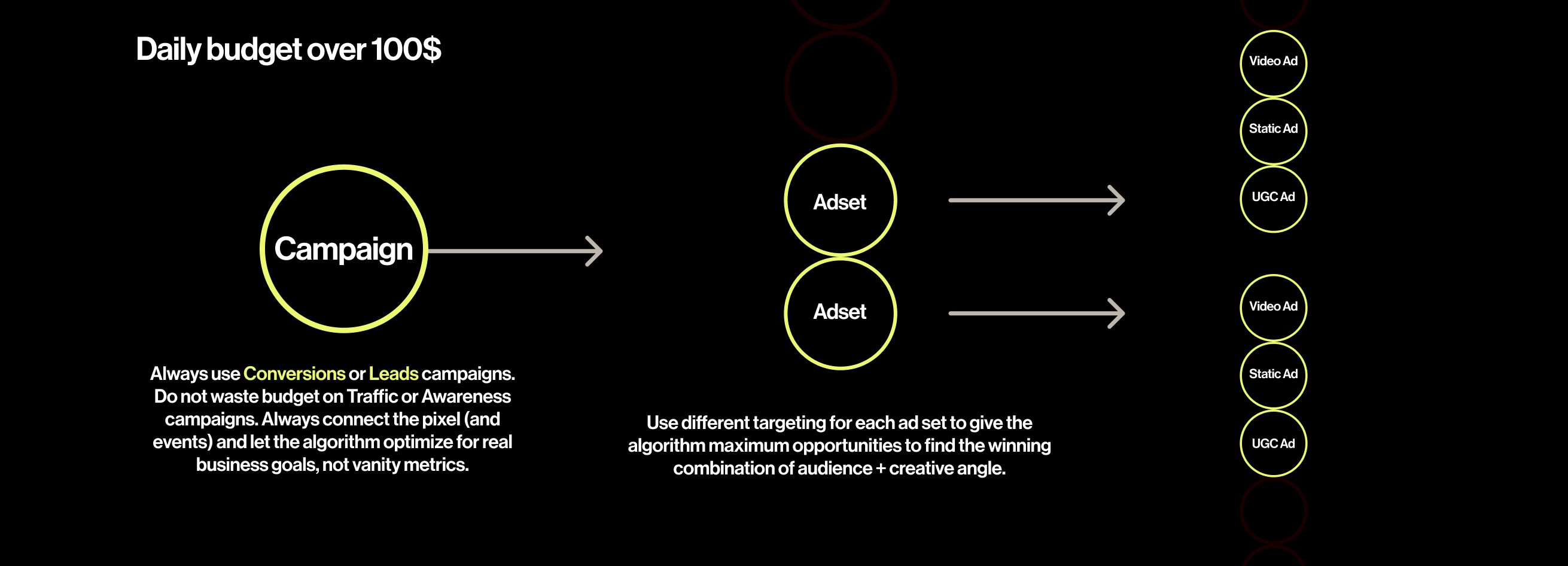
Don’t worry, you don’t need this type of budget right at the start. However it’s good to get an idea of how the scaling phase work.
Recommended setup:
Creatives:
Formats to use:
Goal:
Scale the winning angle as fast as possible.
In a nutshell, if you don’t introduce angle variability into your campaign:
The purpose of running education businesses ads isn’t clicks. It’s connection. You don’t need thousands of leads, you need the right leads - people who feel like your world was built for them. Ads don’t convert by themselves. There is a lot of work no one sees behind the scenes. To reduce a winning campaign to the essential, it needs to have:
MOFU and BOFU structures depend entirely on the funnel you choose.
That’s why, at Qreativa, funnels are not carbon copied - they are designed around your business, your audience and your offer.
